
The past always looks simpler in hindsight.
Time smooths out complexity until a few themes summarize entire decades. The 1980s become the taming of inflation, deregulation, and the rise of Wall Street. The 1990s become the dot-com boom, the end of the Cold War, and globalization. The 2000s become 9/11, the housing bubble, and the financial crisis.
Living through history is messier. The storylines conflict, overlap, and change quickly. We don’t yet know which ones will matter.
This year the messiness feels especially pronounced. The story cycle seems to be running on overdrive, and conflicting signals are everywhere.
Stocks are near all-time highs despite weak consumer confidence and sharply higher interest rates. Artificial intelligence (AI) is producing amazing breakthroughs while driving extraordinary levels of investment, market concentration, and existential anxiety. Another Middle East conflict has pushed oil prices, inflation, and interest rates higher. Yet the economy keeps growing and unemployment remains low.
Different parts of the economy can look like they’re living in different worlds.
Consider what we might have predicted at the beginning of 2026 if we’d known the following:
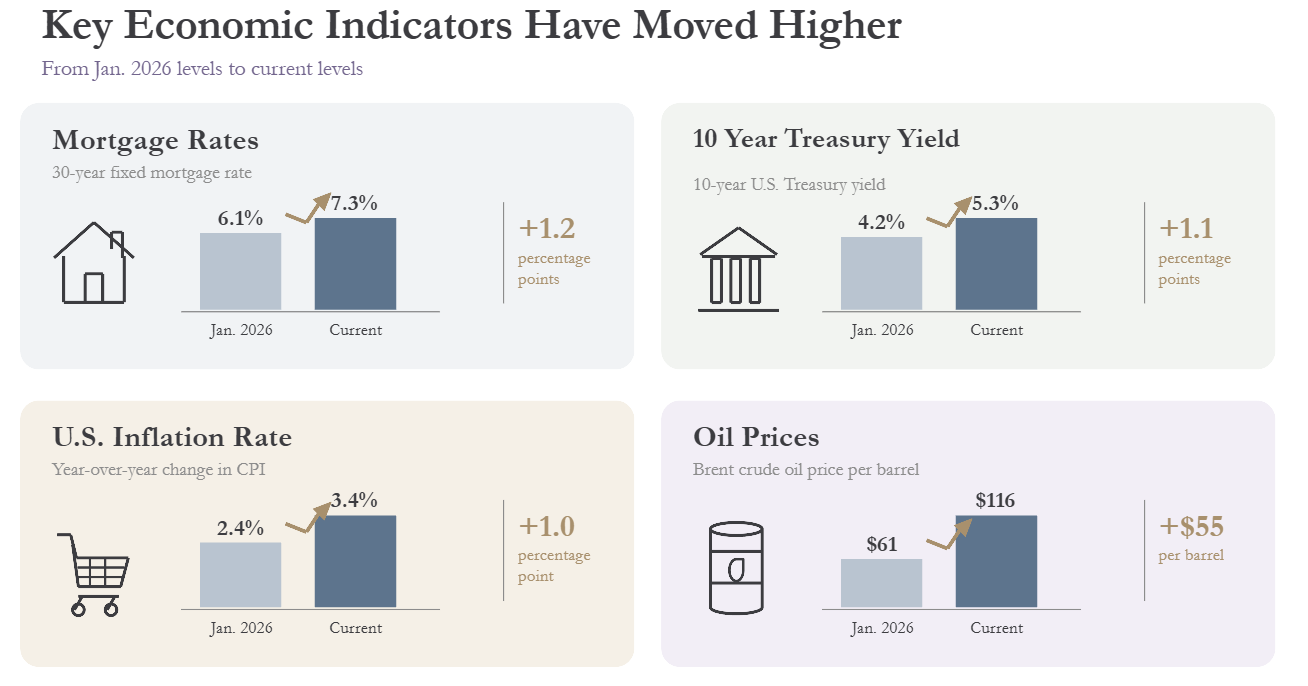
Most investors wouldn’t have guessed that stocks would be up double digits.
Someday, 2026 will be reduced to a tidy storyline too. But we have to invest before knowing what that story will be. Right now, the same set of facts can support very different conclusions depending on where you look.
Stocks Up, Valuations Down
Higher interest rates, higher inflation, surging oil prices, a terrible housing market, and a war would seem like a miserable backdrop for stocks.
Still, stocks have risen throughout much of 2026.
The simplest explanation is also the most important: corporate profits have grown through it all.
In fact, earnings have risen faster this year than stock prices. This means stocks have become less expensive relative to the profits companies are producing. Investors are paying less for the same dollar of earnings than they did to start the year.
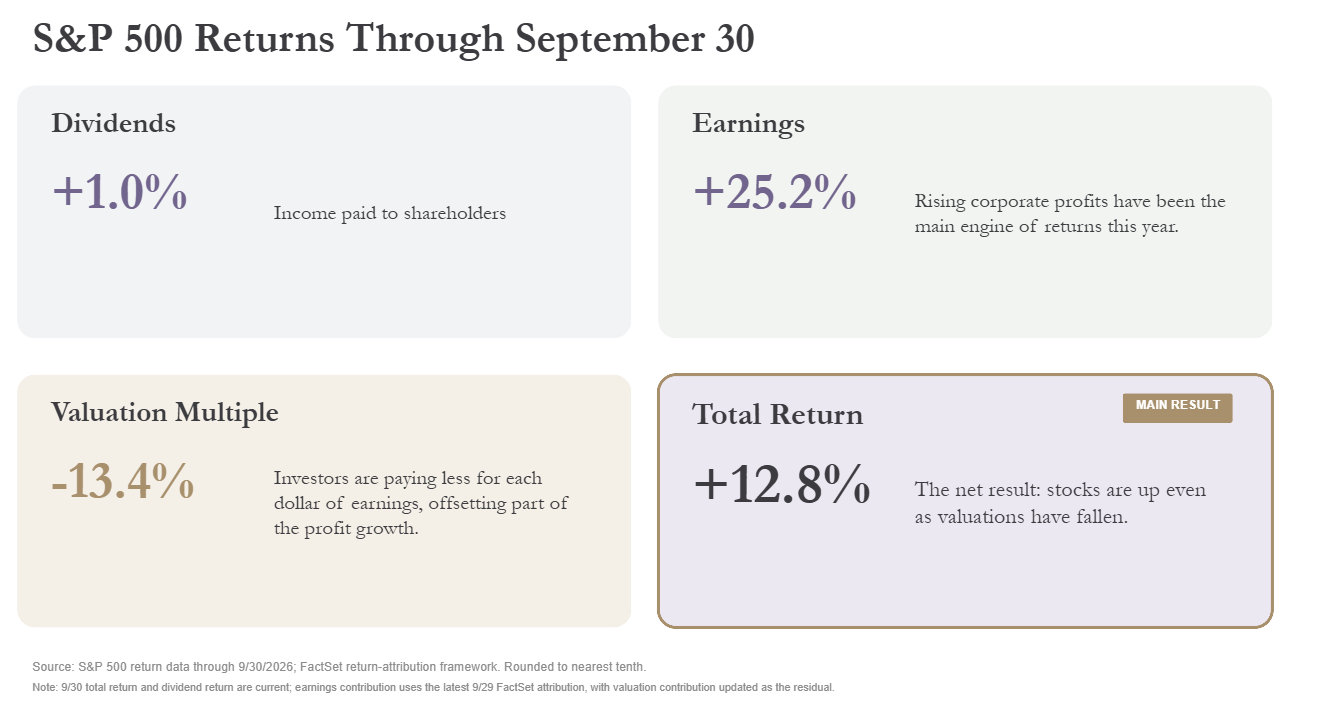
This can be easy to miss when stocks repeatedly hit all-time highs. “Record high” has a way of sounding suspiciously like “expensive.”
But price alone only tells half the story. A stock can rise 10% and become cheaper if its profits rise 20%.
That does not make higher rates, inflation, oil prices, or geopolitical risk irrelevant. Markets can digest a surprising amount of bad news when corporate profits continue to grow.
Higher Rates Hurt First
Higher interest rates tend to create problems for both stocks and bonds, at least initially.
For stocks, there are two main pressures. When safe bonds offer 5+%, stocks face stiffer competition for investors’ dollars. Higher borrowing costs can also weigh on corporate profits.
Bond investors feel the pain more directly. When interest rates rise, the prices of existing bonds fall. A bond paying 2% becomes less valuable when newly issued bonds pay 5%.
That basic math has made the last several years difficult for bond investors. The Bloomberg Aggregate Bond Index suffered its first negative five-year return. Part of bonds’ allure is their ability to diversify stock risk, which makes such poor returns during a stock bull market especially disappointing.
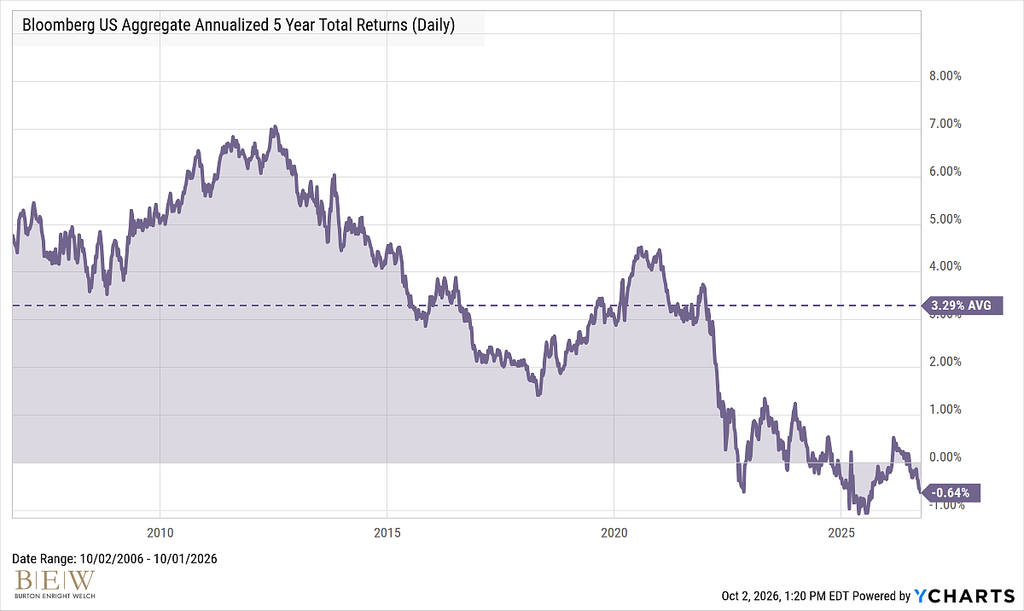
But there is an important silver lining.
The same repricing that caused those losses has also created today’s much more attractive yields. Investors who were earning 1-2% on high-quality bonds can now earn 5+%.
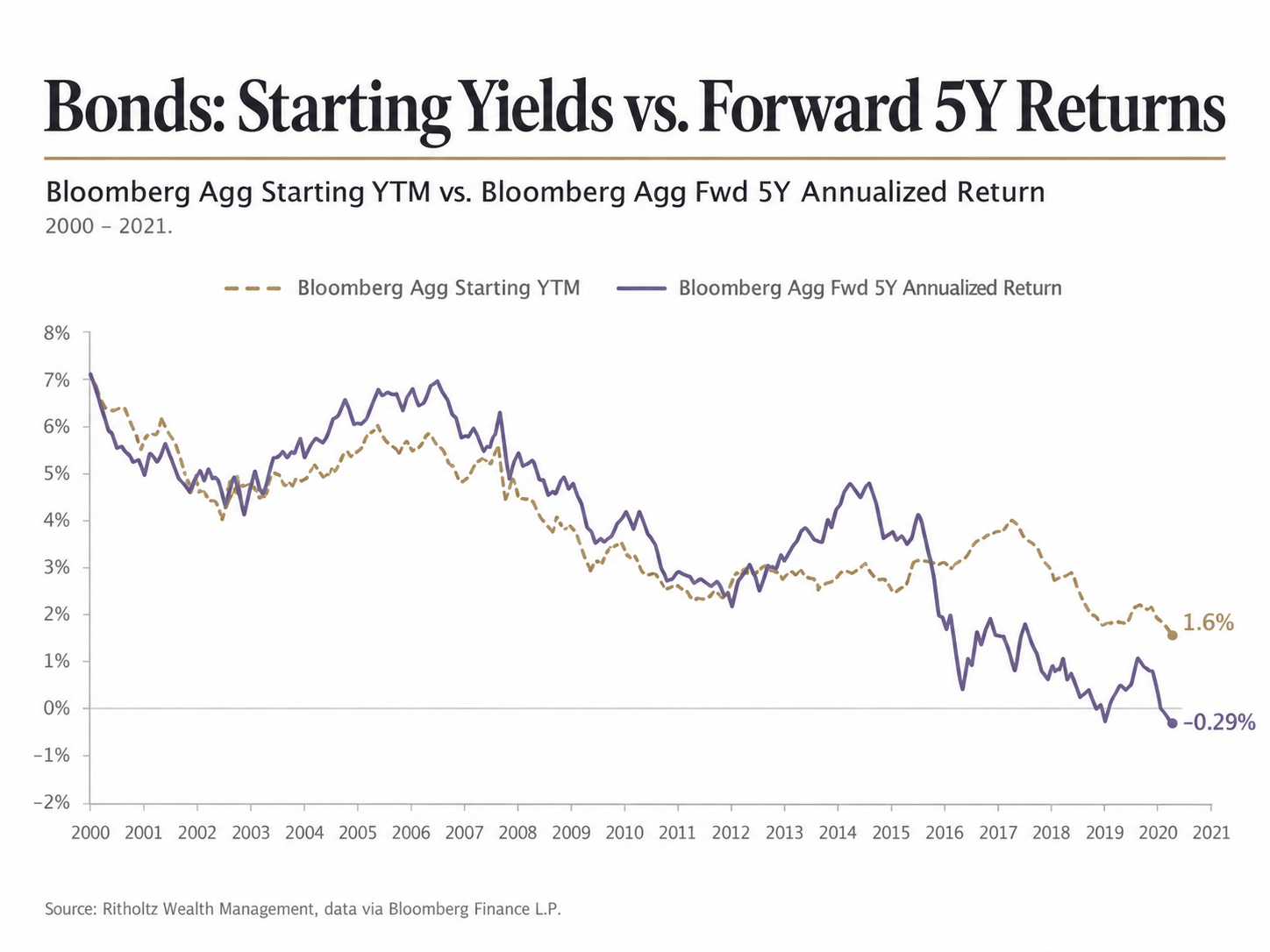
And starting yield matters a lot. Higher yields mean more income, a larger cushion against future price declines, and potential for capital appreciation if rates fall. Historically, starting yields have also been a strong indicator for future returns (see next chart).
For years, low interest rates favored borrowers. Homebuyers locked in cheap mortgages while bond investors earned very little income.
Today, that relationship has flipped.
The conversation around higher rates focuses on the pain they cause borrowers, homeowners, and businesses. Those effects are immediate and easy to see.
The other side of that story receives less attention. A 7% mortgage is painful. A 5% Treasury yield can be attractive. The benefit of those higher yields just takes longer to work its way into portfolios and show up in returns.
Same rates, very different experience.
AI: Extraordinary Promise, Extraordinary Investment
AI is not a speculative story about the future.
It is already improving software development, automating routine knowledge work, accelerating research, and supporting drug discovery. AI’s rapid deployment helps explain the staggering amount of spending on AI infrastructure.
A handful of giant tech companies (“the Hyperscalers”) are spending on AI infrastructure at a scale that exceeds some of the largest technology and infrastructure projects in U.S. history.
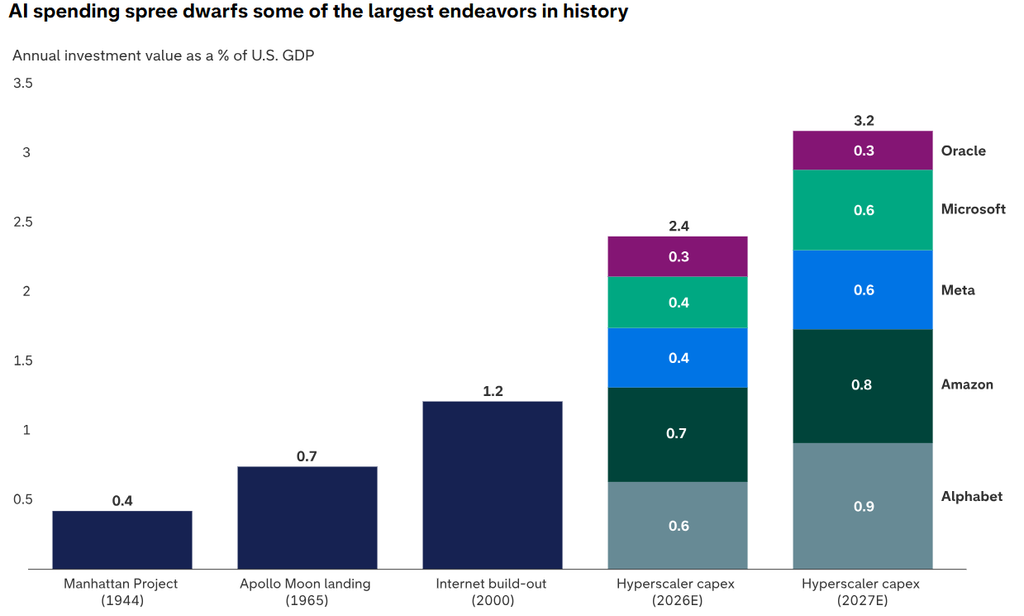
That investment does not occur in isolation. It flows through the economy and supports economic growth and corporate profits.
Enthusiasm is visible in markets too. A relatively small number of companies tied closely to AI now represent an unusually large share of the S&P 500.
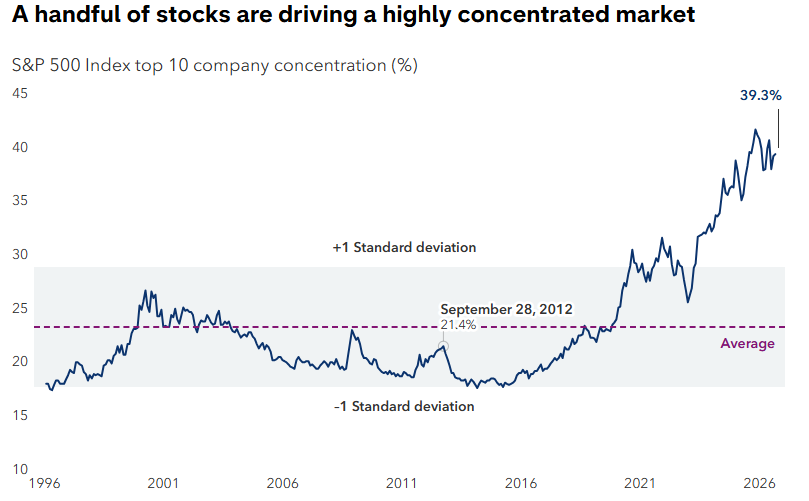
The concentration is striking, but it is not happening in a vacuum. The largest AI-related companies are also generating enormous profits, and as discussed earlier, in many cases earnings are growing faster than their stock prices.
And here again, two things can be true at once.
AI can live up to predictions that it will be the most transformative technology in generations and still create substantial investment risk.
The companies driving the boom may continue to generate extraordinary profits and capture enormous economic value. At the same time, some companies may spend too much, investors may pay too high a price, or today’s leaders may ultimately capture less of that value than expected.
The more transformative AI proves to be, the easier it is to justify massive investment … and the easier it is for investors to overpay for that transformation.
Investing Before the Story Is Written
None of these tensions needs to be resolved for investors to succeed.
We don’t need to know whether rates will rise or fall next, exactly how much of today’s AI spending will pay off, or which headline will dominate the next quarter.
Markets always contain conflicting signals. In hindsight, history turns messy periods into neat narratives. In real time, they rarely cooperate.
That is another reason why global diversification matters. We build portfolios designed to thrive over the long term across a range of outcomes, rather than depend on any single forecast or storyline.
Headlines will always prefer a clean story. Portfolios don’t need one.
Get the BEW Newsletter Direct to Your Inbox
Stay informed with timely perspectives and market insights from the BEW Invest team.