
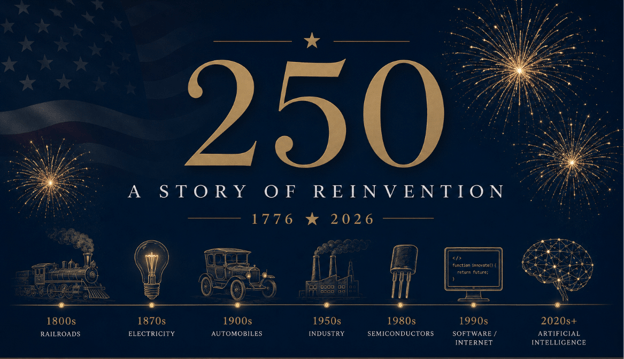
The United States turned 250 years old a few days ago.
For investors, the milestone is a chance to celebrate one of history’s most remarkable engines of innovation and wealth creation.
Every generation has been convinced that America’s best days were behind it. There have been plenty of reasons for pessimism: World Wars, the Great Depression, inflation, stock market crashes, financial crises, pandemics, and countless geopolitical shocks.
Yet after every setback, new companies emerged, old industries faded, capital flowed toward new ideas, productivity improved, and profits grew. Continual reinvention has been the defining characteristic of the American corporate sector.
None of this diminishes the importance of diversification. We remain firm believers in building global portfolios because leadership changes and surprises are inevitable. But diversification doesn’t require pretending every market has followed the same trajectory.
The System Behind the Success
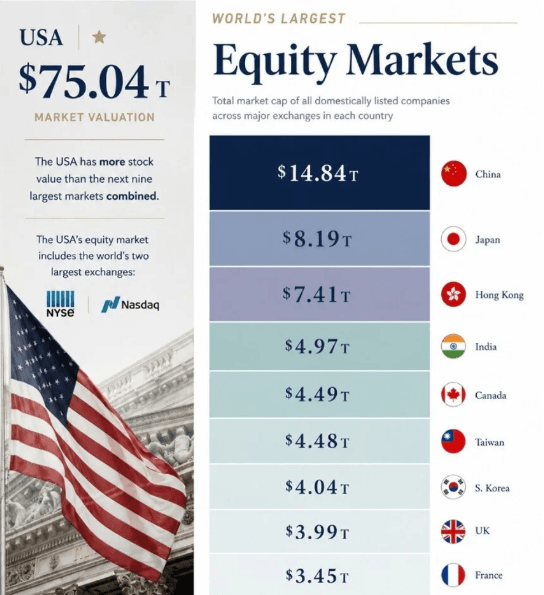
The United States is home to roughly 4% of the world’s population and produces about one-quarter of global GDP. Yet American companies represent 60% of the world’s publicly traded equity market and generate one-third of global corporate profits.
Let’s set aside the debate whether U.S. leadership is fading. Instead, it’s worth asking: why has it persisted for so long?
America has several advantages that reinforce one another:
- Deep and liquid capital markets
- The world’s reserve currency
- Strong legal institutions
- World-class universities
- An entrepreneurial culture that tolerates failure
- The deepest venture capital ecosystem in the world
None of those advantages is unique. Their power comes from how they reinforce one another.
Together, they create a system that has proven remarkably effective at turning ideas into successful businesses.
It’s tempting to credit America’s success to whichever breakthrough technology dominates headlines. Today, it’s Artificial Intelligence (AI). Before, it was the internet, personal computers, and electricity.
But the most enduring competitive advantage is the system itself. It repeatedly commercializes new ideas, attracts capital, and scales businesses on a global stage.
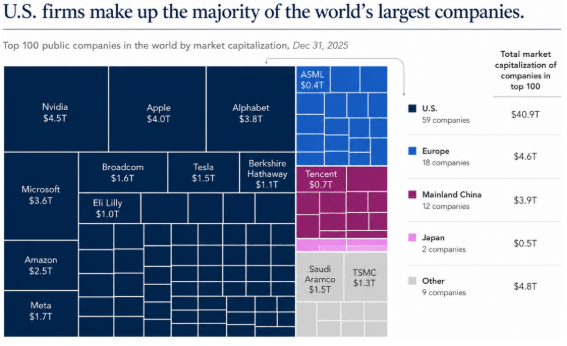
Fifty-nine of the world’s 100 largest publicly traded companies are American.
More interesting than the number is the diversity behind it.
Technology companies sit alongside leaders in healthcare, industrials, finance, and consumer businesses.
Corporate America’s greatest strength hasn’t been one winning industry. It’s been the ability to create the next one.
You’re Not Just Buying Today’s Great Companies
Perhaps America’s greatest invention isn’t the light bulb, the airplane, or AI. It is the world’s most effective system for turning ideas into great companies.
Sometimes, the case for stock market growth feels circular: investing has worked in the past, so it will work in the future.
But owning stocks isn’t just a bet on today’s largest companies. It’s a bet that the system that created yesterday’s winners will continue creating tomorrow’s.
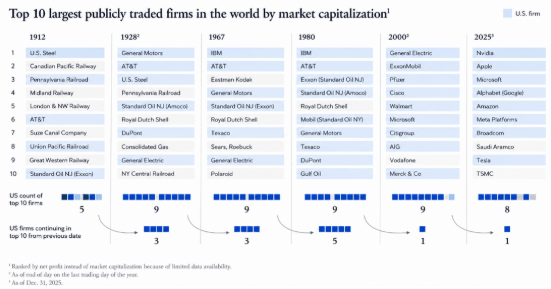
The companies changed. The process did not. Railroads gave way to oil companies. Oil companies gave way to industrial conglomerates. Then came software, the internet, and semiconductors.
The remarkable part isn’t that America has produced great companies. It’s that, generation after generation, it keeps producing them.
That’s one of the hidden strengths of broadly diversified portfolios. Owning most companies means you don’t simply own yesterday’s winners. You continually acquire tomorrow’s.
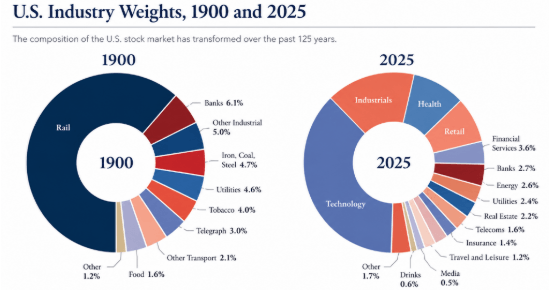
In 1900, roughly 80% of the U.S. stock market consisted of railroads, steel, coal, textiles, utilities, and other industries that powered the Industrial Revolution.
Today, nearly 70% of market value comes from industries that were either tiny or didn’t exist at all 125 years ago.
Imagine trying to predict that in 1900.
An investor buying the U.S. stock market at the turn of the 20th century wasn’t simply buying railroads. That investor was buying a system that would eventually replace railroads.
The Pattern of Reinvention
Every innovation cycle is unique. Yet they tend to rhyme.
Looking back, a familiar pattern emerges:
- A breakthrough technology changes what’s possible
- Capital floods into the opportunity
- Expectations race ahead of reality
- Early winners dominate investor attention
- The technology spreads across the broader economy
- New leaders emerge that few predicted at the outset
Railroads, electricity, automobiles, computing, and the internet all followed some version of this arc. There is little reason to believe AI will be the exception.
The pattern is easy to recognize in hindsight. Living through it is another matter.
Capital concentration can become a bubble. Rising expectations can turn into overconfidence. Early winners can appear untouchable.
Eventually, speculation fades. The innovation often remains.
AI: The Latest Chapter
AI is simply the latest chapter in that story.
In late 2022, inflation was running at its highest level in decades. The Federal Reserve was aggressively raising interest rates. The S&P 500 had fallen nearly 25% from its peak. Investor sentiment was bleak.
Then, quietly, ChatGPT was released.
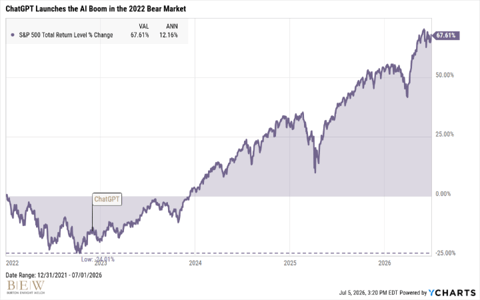
ChatGPT did not emerge in isolation. It was the latest product of decades of investment in research universities, entrepreneurial talent, venture capital, semiconductor innovation, and public and private markets willing to finance patient, long-term investment.
We’ll never know how markets would have evolved had AI not emerged when it did. Still, this is a common story. Just when one cycle appears exhausted, the seeds of the next are already being planted.
AI is today’s transformative technology. Hundreds of billions of dollars are being invested in data centers, semiconductors, and computing infrastructure. Economists are debating how much productivity AI will ultimately unlock. Investors have rewarded AI infrastructure companies (Nvidia, Broadcom), while the frontier AI labs (OpenAI, Anthropic) have become some of the most valuable private companies in the world.
But perhaps the most interesting part of the story is what may come next.
For much of the past few years, market leadership was concentrated in a handful of giant companies. More recently, leadership has begun to widen as investors look toward the businesses that may ultimately benefit from the technology.
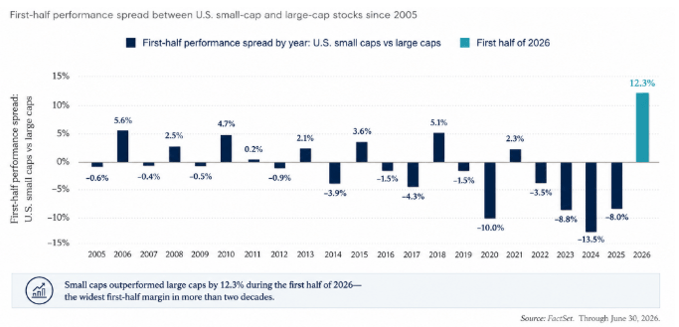
If the historical pattern holds, that broadening may continue for years. The biggest long-term winners from AI may not be today’s builders, but tomorrow’s users.
Of course, history guarantees nothing.
Every innovation cycle has encountered setbacks, disappointments, and periods of excessive optimism. This cycle will almost certainly be no different.
The challenge isn’t identifying the next wave of innovation. It’s remaining invested long enough to participate wherever it ultimately creates value.
Happy 250!
For us, that’s the enduring lesson of the past 250 years.
Investing has always been an exercise in optimism. Not optimism that every company will succeed, every innovation will pay off, or every year will be rewarding.
It’s optimism that people will continue solving problems, businesses will continue creating value, and markets will continue finding ways to finance the next generation of ideas.
So as America celebrates its 250th birthday, we’re celebrating history’s greatest engine of innovation and wealth creation – American capitalism at its best – adaptive, entrepreneurial, and continually reinventing itself.
Get the BEW Newsletter Direct to Your Inbox
Stay informed with timely perspectives and market insights from the BEW Invest team.